Common plumbing problems in Downtown Cleburne historic homes
Galvanized supply lines, clay sewer laterals, and undersized vent stacks cause most plumbing failures in Downtown Cleburne's historic homes. Here's what to fix first.
The most common plumbing problems in Downtown Cleburne historic homes are galvanized steel supply lines that have rusted shut, clay or cast iron sewer laterals cracked by tree roots, undersized vent stacks, and slab or pier-and-beam leaks caused by decades of soil movement. Almost every house built between 1900 and 1960 around the Johnson County courthouse square is still running at least one of those systems today.
We work on these houses every week, and the failure patterns are predictable once you know what to look for. Below we break down each problem, what it costs to fix in 2026, and when a repair stops making sense and repiping becomes the smarter call.
Why Downtown Cleburne Historic Homes Have So Many Plumbing Problems
Downtown Cleburne's housing stock was built for a different era of plumbing - lead service lines, galvanized steel, and clay tile drains that were never designed to last 80 years. The neighborhoods around Anglin Street, West Henderson, and the blocks radiating off Main Street still carry that original infrastructure under the floors.
Three things accelerate the wear. First, Cleburne's soil is heavy black clay that swells when it rains and shrinks hard in summer drought, and that cycle flexes buried pipes until joints fail. Second, our water runs hard - high mineral content that scales the inside of galvanized pipe faster than soft water would. Third, most of these homes have had partial remodels over the decades, so you'll find 1920s galvanized feeding a 1990s copper stub-out feeding a 2015 PEX line, all tied together with no consistent pressure rating.
That mixed-metal patchwork is where a lot of the trouble starts. Dissimilar metals corrode each other at the connection point, and every remodel added another joint that can leak.
What plumbing problems are common in Downtown Cleburne historic homes?
The short answer: low water pressure from corroded galvanized lines, recurring drain backups from root-intruded clay sewer laterals, leaking toilet flanges and wax rings, failed water heater connections, and slab or crawlspace leaks that show up as a hot spot on the floor or a spike in the water bill.
Here's the list we see most often, roughly in order of how many calls each one generates:
- Galvanized supply pipe corrosion - rusty brown water, weak shower pressure, pinhole leaks at threaded joints.
- Clay sewer lateral root intrusion - slow drains throughout the house, gurgling toilets, sewage smell in the yard.
- Cast iron drain decay - channeling along the bottom of horizontal runs until the pipe is paper-thin.
- Toilet flange rot - the closet flange rusts away from the floor, and the toilet rocks and leaks at the base.
- Undersized or blocked vent stacks - drains that glug and pull the trap dry, letting sewer gas into the house.
- Water heater age-out - tanks installed before 2015 are past their expected service life and start weeping at the fittings.
If you're seeing more than two of those at once, you're usually looking at a system-wide problem rather than a single failed part. That's when it makes sense to bring in a plumber who works on old houses regularly rather than patching one symptom at a time.
Galvanized Steel Supply Lines: The Number One Failure Point
Galvanized steel was the standard supply pipe from roughly 1900 to 1960, and it has a service life of about 40 to 50 years before the zinc coating wears through and the steel underneath starts to rust from the inside out. In a Downtown Cleburne house built in 1948, that pipe is now 78 years old.
The failure is gradual and easy to miss. You'll notice the kitchen faucet takes longer to get hot, then the shower pressure drops, then the water comes out slightly brown after a vacation when it's been sitting in the pipe. By the time you see pinhole leaks, the interior diameter of the pipe is often reduced by 50 to 70 percent from scale and rust.
You can't clean that out. Snaking or descaling a galvanized line buys you a few months at best before the rust flakes break loose again and clog your aerators. The real fix is replacement, and for a whole-house situation that means repiping.
Most Downtown Cleburne repipes we do run $4,500 to $9,500 in 2026 depending on square footage, how many fixtures need to be tied in, and whether the walls are open. A 1,400-square-foot bungalow with three fixtures sits at the low end; a two-story 2,600-square-foot house with two full baths and a kitchen remodel sits at the top. If you want the full breakdown of what repiping Cleburne TX involves, we cover materials, wall access, and timeline on that page.
Clay and Cast Iron Sewer Laterals Under Downtown Cleburne
The sewer line running from your house to the city main is almost certainly the original clay tile if your home predates 1970, and clay tile cracks. It also has open joints every three feet, which is exactly what tree roots are looking for.
Live oak, pecan, and elm roots find the moisture in a cracked joint and push through. Once inside, they expand and block the line. You'll see it first as a single slow drain, then two, then a backup in the lowest fixture in the house - usually a basement floor drain or the downstairs tub.
We run a camera down the line before we quote anything. What the camera shows determines the fix:
- Roots only, pipe intact - sewer line cleaning Cleburne TX with a cutting head clears the intrusion, and an annual visit keeps it clear.
- Cracked or offset pipe, roots returning - spot repair or full lateral replacement.
- Collapsed section under a driveway or mature tree - trenchless replacement, which avoids tearing up the yard.
Full lateral replacement in Cleburne typically runs $4,000 to $12,000 in 2026, with trenchless methods at the higher end because of the equipment involved. Spot repairs on a single bad joint land between $800 and $2,500. If you're weighing options, the difference between a sewer line repair Cleburne TX and a full replacement usually comes down to how many bad sections the camera finds.
Slab Leaks and Pier-and-Beam Plumbing in Older Cleburne Homes
Downtown Cleburne has both slab-on-grade and pier-and-beam houses, and each fails differently. Pier-and-beam is easier to work on - the pipes hang in the crawlspace and you can see a leak the moment it starts dripping. Slab-on-grade hides everything under four inches of concrete.
A slab leak announces itself in one of four ways: a hot spot on the floor (hot water line), the sound of running water when nothing is on, a water bill that jumps 30 to 50 percent in a month, or cracks appearing in tile or drywall. Left alone, a slab leak undermines the foundation and can cost five figures to correct.
We locate slab leaks with acoustic listening equipment and thermal imaging before we cut anything. Most slab leaks we repair in Cleburne run $1,200 to $3,500 in 2026 for the leak itself, plus drywall and flooring repair. If the camera and pressure test show multiple failing sections in the same line, rerouting the line overhead through the attic is often cheaper than chasing leaks through concrete one at a time.
For crawlspace homes, we check the pipe hangers while we're under there. Old galvanized or copper lines sagging on rusted straps will fail at the hanger point, and it's a ten-minute fix while we're already in the space.
Water Heaters, Venting, and Code Gaps in Pre-1960 Houses
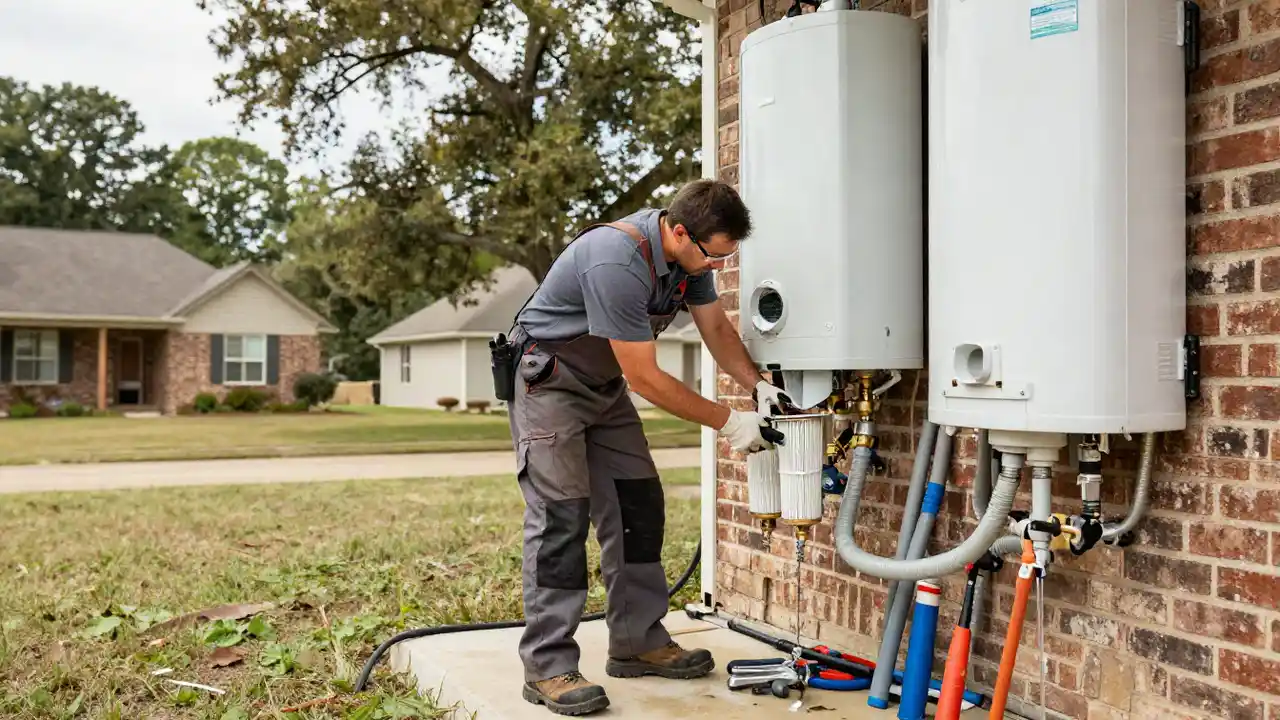
Water heaters in historic Cleburne homes fail for the same reason the supply lines do - they're old, and the connections around them were never updated. A tank installed in 2010 is at the end of its 10-to-12-year life right now, and the fittings feeding it are often original galvanized.
Three specific problems come up again and again:
- Galvanized nipples on the tank - the dielectric union was never installed, so the steel tank and the copper house line corrode each other. The tank fails at the top fitting within a few years.
- Undersized flue and no drip leg - older gas water heaters in these homes often vent into a shared masonry chimney that's too large for the flue volume, which lets exhaust cool and backdraft into the house.
- No expansion tank or pan - required on closed systems since the 1990s, and missing on most pre-1960 installs. When the tank fails, water goes straight onto the floor.
Replacing a failed tank in a Downtown Cleburne home runs $1,400 to $2,800 in 2026 for a standard 40-to-50-gallon gas unit, including a new pan, expansion tank, and proper venting. If you're replacing anyway and want to stop paying to heat a tank of standby water, a tankless water heater installation Cleburne TX runs $3,200 to $5,500 installed and frees up closet space these older homes never had to spare.
Should I repipe a historic home in Downtown Cleburne?
Yes, if your home still has galvanized supply lines and you've had two or more leaks in the past 24 months. At that point you're paying for emergency repairs faster than you'd pay for a repipe, and you're living with low pressure and rusty water the whole time.
The math usually works out like this. A single emergency leak repair on galvanized pipe runs $350 to $900. Three of those in two years is $1,500 to $2,700, and you still have the original pipe. A full repipe at $4,500 to $9,500 ends the problem for 50-plus years and typically raises resale value because the buyer's inspector stops flagging it.
What we don't recommend is repiping a house that only has one isolated problem. If the camera shows a single cracked joint in an otherwise sound cast iron drain, fix the joint. If the pressure test shows one bad section of copper, fix the section. Repiping is for systems that have failed in multiple places, not for one bad fitting.
One more thing on historic homes specifically: we route new PEX or copper to preserve original tile, plaster, and trim wherever we can. That means fishing lines through existing chases and cutting access panels in closets instead of opening up a wall in the front room. It takes longer, and it's worth it.
What to Watch Out For Before You Hire Anyone
Historic homes attract two kinds of bad plumbing work: the cheapest bid, and the contractor who doesn't know old houses. Both cost you more in the long run.
Watch for these:
- A quote without a camera inspection on a sewer problem. Nobody can price a sewer repair from the surface. If they won't run a camera, they're guessing.
- Pressure-only leak detection. A pressure test tells you there's a leak. It doesn't tell you where. Insist on acoustic or thermal location before anyone cuts concrete.
- Galvanized-to-copper connections without dielectric unions. This is the single most common shortcut we find on remodels, and it guarantees a failure within a few years.
- No permit pulled on a water heater or sewer replacement. Cleburne requires permits on both, and unpermitted work becomes your problem at resale.
- Whole-house repipe quotes that don't include drywall repair. Ask what's included before you sign.
We give you the camera footage and the pressure test results before we quote. If the fix is a $400 repair, we'll tell you that instead of selling you a repipe.
When to Call a Professional
Call us the same day if you see water pooling near the foundation, smell sewage inside the house, hear water running when every fixture is off, or lose hot water entirely. Those four symptoms point to a slab leak, a broken sewer line, or a failed water heater, and none of them get better on their own.
For slower problems - dropping pressure over months, one drain that backs up every few weeks, a water bill creeping up - you can schedule a diagnostic visit rather than an emergency call. We'll camera the drain, pressure-test the supply, and give you a written scope with pricing before any work starts.
Cleburne Trailcrest Plumbing works on historic homes across Downtown Cleburne and the surrounding neighborhoods. We know the pipe materials, the soil, and the code requirements for these houses, and we've done enough of them to know what a fair price looks like. Whether it's a single plumbing repairs Cleburne TX visit or a full system replacement, we'll tell you honestly which one you actually need.
Frequently Asked Questions
What plumbing problems are common in Downtown Cleburne historic homes?
Galvanized steel supply lines that have corroded shut, clay or cast iron sewer laterals cracked by tree roots, undersized vent stacks, and slab or crawlspace leaks from soil movement. Most homes built between 1900 and 1960 around the courthouse square still have at least two of these systems in place.
How do I fix old plumbing in a historic Cleburne home?
Fix the specific failure first - a camera inspection on drains, a pressure and acoustic test on supply lines - then decide whether the repair is isolated or the system is failing in multiple places. Isolated problems get spot repairs; system-wide failures get repiped. Expect $400 to $2,500 for most single repairs in 2026.
Should I repipe a historic home in Downtown Cleburne?
Repipe if you have galvanized supply lines and two or more leaks in 24 months. A full repipe runs $4,500 to $9,500 in 2026 and lasts 50-plus years. If you have one isolated bad section, fix the section instead - repiping a sound system is money wasted.
Who repairs plumbing in Downtown Cleburne TX?
Cleburne Trailcrest Plumbing handles historic home plumbing across Downtown Cleburne and Johnson County, including repiping, sewer camera inspections, slab leak detection, and water heater replacement. We work on the original pipe materials these houses were built with and pull the required city permits on every job.
How long does a repipe take on an older Cleburne home?
Most single-family repipes take three to five working days, with water restored each evening. Homes with original plaster walls or complex routing can run six to eight days. We handle drywall patching as part of the job so you're not coordinating a second contractor.
Get help with plumbing in Cleburne
If your historic home is showing any of the symptoms above, we'll come out, run the camera and the pressure test, and tell you exactly what's failing and what it costs to fix. One call gets you a straight answer and a written price.
Call Cleburne Trailcrest Plumbing at (682) 468-2111 to schedule a diagnostic visit or same-day emergency plumbing Cleburne TX service.